

Rotana CenterRotana Center
Rotana CenterRotana Center
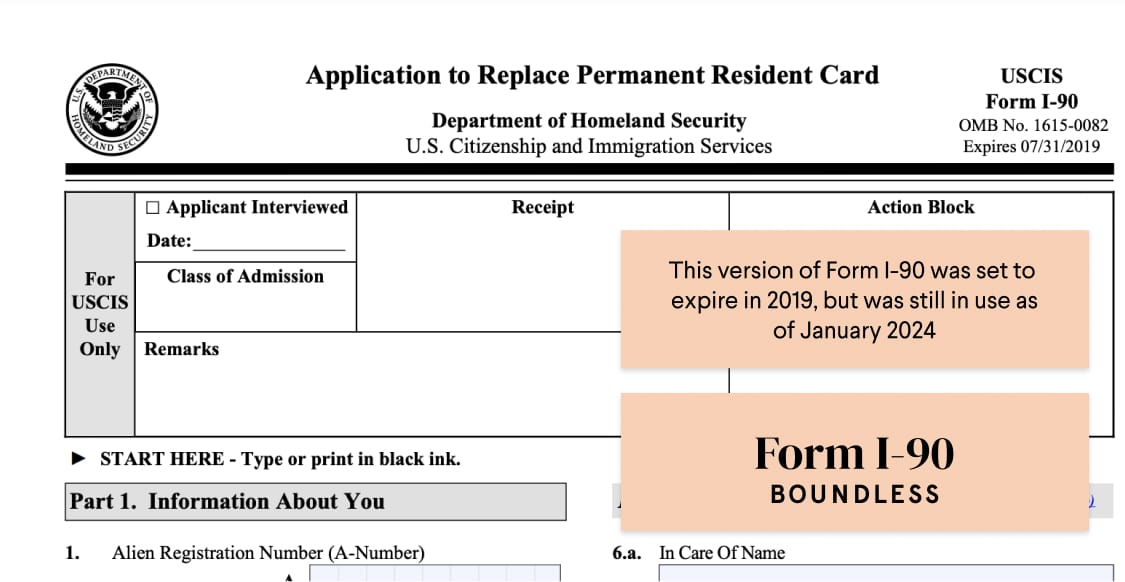
The I-90 form (officially called the “Application to Replace Permanent Resident Card”) is the application used to renew or replace a green card. You must file Form I-90 with U.S. Citizenship and Immigration Services (USCIS) if your green card is expired or soon-to-expire or if it has been lost, stolen, damaged, or destroyed, among other reasons.
Starting Sept. 10, 2024, USCIS extended green card validity to 36 months for anyone filing Form I-90 to renew their card. Previously, the extension was 24 months. The receipt notice can be used with an expired green card as proof of status and work authorization. This change helps cover longer processing times.
Not every permanent resident must file Form I-90 to get a new permanent resident card (aka green card). Here’s a general overview of who should and should not file Form I-90:
Most permanent residents use Form I-90 when they need to renew or replace their green card. These include permanent residents whose 10-year green cards have expired or will be expiring in the next 6 months, as well as permanent residents whose green cards, for example, have been lost, stolen, damaged, or completely destroyed. See below for a list of situations when a Form I-90 is needed.
If you have a conditional green card, which expires 2 years after being issued, you must follow a different process to replace it with a “permanent” green card that’s valid for 10-year renewable periods. That process is known as “removing the conditions” on the green card. You’ll file Form I-751 (officially called the “Petition to Remove Conditions on Residence”) if you have a conditional marriage-based green card or Form I-829 (officially called the “Petition by Entrepreneur to Remove Conditions on Permanent Resident Status”) if you gained U.S. permanent residence by investing in a U.S. business.
Boundless + RapidVisa can help you complete your application and guide you all the way to the finish line on your I-90 application. Ready to start?
Depending on the reason you’re requesting a new green card, you may file Form I-90 either online or by mail (using a paper Form I-90):
| Who may file the I-90 online? | Who must file the I-90 by mail? |
|---|---|
| Your green card is expired or expiring within 6 months. | You’re applying for a fee waiver. |
| Your green card was lost, stolen, mutilated (damaged), or destroyed. | Your green card was issued, but you never received it. |
| Your name or other personal information has changed. | Your green card contains an error (or errors) made by USCIS. |
| You have an old — and now invalid — version of the green card. | You received a 10-year green card before age 14, and it will not expire before you turn 16. |
| You’re a “commuter,” meaning you live in either Canada or Mexico but travel to the United States for work. | |
| You’ve been a “commuter” (see row above) but now live in the United States. | |
| Your immigration status was automatically converted to “green card holder” (applies to a narrow group of people, such as “Special Agricultural Workers”). |
If you’re filing a paper I-90 by mail, you must send your form, supporting documents, and payment (if applicable) to one of the following addresses, depending on the shipping method you choose:
| Through the U.S. Postal Service (USPS) | Through DHL, FedEx, or UPS |
|---|---|
| USCIS P.O. Box 21262 Phoenix, AZ 85036 | USCIS Attention: I-90 1820 E. Skyharbor, Circle S, Floor 1 Suite 100 Phoenix, AZ 85034 |
In this section, we’ll take a closer look at each section of Form I-90 (the official Form I-90 instructions are available on the USCIS website, under “Filing Options”). But first, let’s cover some ground rules:
This section is mostly straightforward. It asks for basic personal information, such as your name, parents’ names, birth date, and gender.
Other questions that may not be as obvious:
If you have a disability or need help to complete this application — for example, if you’ll be arriving in a wheelchair at your biometrics appointment — you can use this section to ask for assistance and explain what accommodations would be helpful.
It’s essential for you to understand that you’re signing a legal document. If you needed help completing Form I-90, you’ll need to indicate in this section that you used an interpreter and/or attorney to help you. They must also sign the form and provide some personal information.
If you needed extra space to answer any of the questions in the previous sections of Form I-90, you would enter or write that information here.
If this page still does not provide enough space for your answers, you can attach separate sheets of paper — just make sure to include your name and A-Number (if you have one) at the top of each sheet. For every question that you’re providing an additional answer, make sure to indicate the page number, part number, and item number. And finally, don’t forget to sign and date each sheet!
The confirmation letter you receive from USCIS will include a 13-character “receipt number” (3 letters and 10 numbers). You can use this receipt number to track the progress of your I-90 application.
To check the status of your application, you’ll need to use the USCIS “CHECK STATUS ONLINE” tool. Enter your receipt number in the space provided, and then click “Check Status.” If you entered your receipt number correctly, you will be able to view when USCIS received your application and its current status.
Do not include the dash symbol (-) but do include the asterisk (*) — if there is one — when entering your receipt number.
The average processing time for Form I-90 is currently 0.7 months.
Have questions about wait time? Visit Boundless and RapidVisa’s 1-90 immigration service for answers!
The current filing fee for Form I-90 is $465 for paper filing and $415 if you file online. Please note this fee is nonrefundable.
However, you may be exempt from paying the fee.
How you’ll pay depends on whether you filed Form I-90 online or by mail:
A fee waiver is available for Form I-90 if you meet certain requirements.
To qualify for a fee waiver, you must prove to the U.S. government that you cannot afford the fees because you have low income, experience financial hardship, or receive public benefits.
To apply for a fee waiver, you must complete a separate form and submit supporting documentation about your financial situation. If approved, both the filing fee ($ total) will be waived, and you will pay $0.
See our guide to immigration fee waivers to learn more.